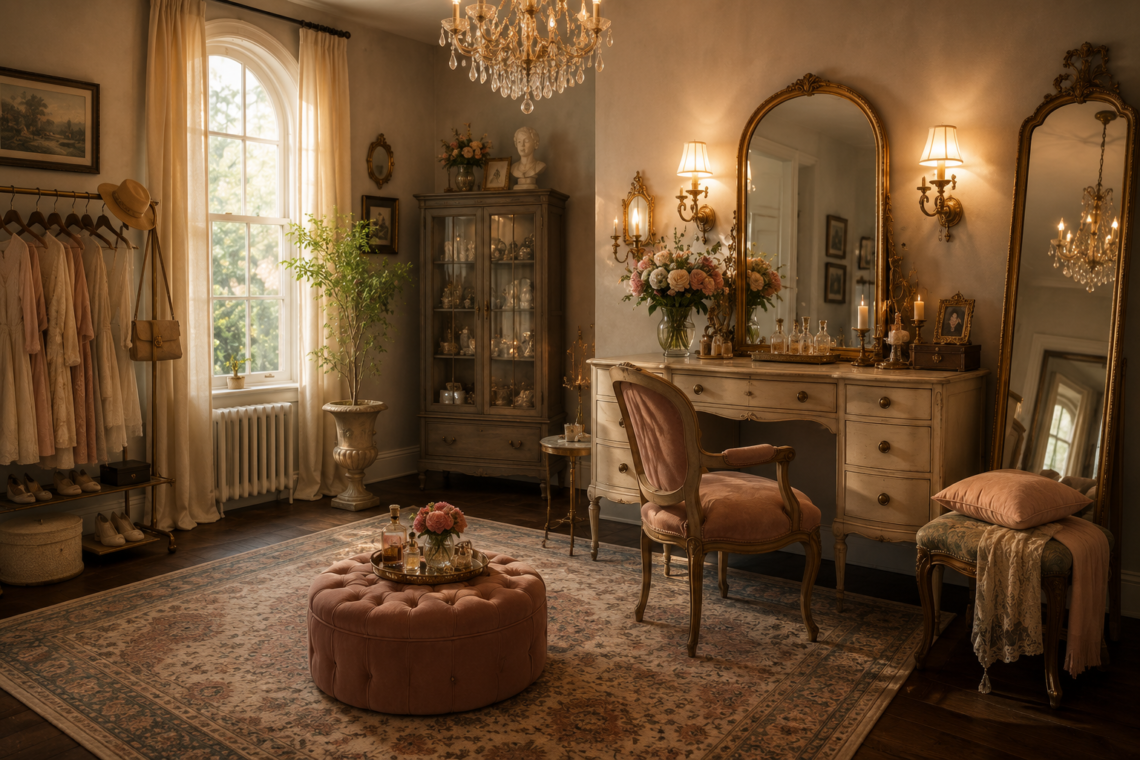
There’s a difference between a room that references the past and a room that looks like a costume department built it. A truly beautiful vintage dressing room doesn’t shout its era. It borrows the parts of old-world glamour that still feel relevant — the curved silhouettes, the warm brass, the soft-focus mirrors — and lets them sit comfortably inside a home that’s lived in today.
The goal isn’t to recreate a movie set. It’s to build a space where getting dressed feels like a small ceremony instead of a rushed five minutes before you’re out the door. Here’s how to get there, piece by piece.
Start With the Vanity, Not the Decor
Every vintage dressing room begins with the vanity, and it’s worth spending your budget here before anywhere else. Look for a silhouette with some curve to it — a kidney shape, a scalloped apron, or gently tapered legs. Wood finishes in walnut, cherry, or a soft antique white read as vintage without needing a single distressing technique. If floor space is tight, a wall-mounted or corner vanity gives you the same presence in a fraction of the footprint.
Choose a Mirror That Does the Work
A plain rectangular mirror will flatten the whole look. Vintage-inspired dressing rooms lean on mirrors with real presence — arched tops, sunburst frames, or a trio of smaller mirrors angled like a dressing-table triptych. Brass or aged-gold frames warm up the room instantly, and if you can find one with slightly imperfect, antiqued glass, even better. That soft distortion is part of what makes old mirrors feel romantic instead of clinical.
Seating Should Feel Collected, Not Matched
Skip the vanity stool that comes bundled with a big-box set. A small tufted bench, a cane-back chair, or even a slipper chair pulled from another room instantly makes the space feel like it evolved rather than arrived in one delivery truck. Velvet, boucle, or a faded floral upholstery all read as vintage-adjacent without tipping into costume territory.
Storage That Hides the Clutter
Glamour falls apart fast when it’s competing with visible clutter. A dresser with fluted or reeded drawer fronts, curved corners, or brass cup pulls will handle the heavy lifting — folded clothing, accessories, everyday jewelry — while still looking intentional if left open. Pair it with a lidded box or two on top for the small things that don’t have a home, like hair clips or loose jewelry.
Lighting Sets the Mood More Than Anything Else
Overhead lighting alone will make even the prettiest vanity feel like a bathroom. Layer in a pair of sconces flanking the mirror, or a string of small bulbs around the frame, for that theatrical, old-Hollywood glow. Warm bulbs — not daylight or cool white — are non-negotiable here. A small lamp on the vanity itself adds a second layer of warmth for evenings.
Fabric and Textiles Carry the Softness
Hard surfaces alone will feel stiff. A skirted vanity stool, a small area rug in a faded pattern, or a curtain panel used as a soft room divider all add the textural softness that vintage rooms depend on. If you want pattern, look for small florals, ticking stripes, or subtle damask — anything busy and modern-graphic will fight the mood instead of supporting it.
Antique-Inspired Details Worth Adding
A few small details go a long way: a glass or crystal-knobbed pull on a drawer, a perfume tray, a hand mirror displayed rather than stored, or a small framed piece of vintage-style art. These are inexpensive additions that do a lot of visual work, and they’re the easiest things to swap out if your taste shifts later.
Small-Space Alternatives
Not everyone has a spare room for this. A narrow wall-mounted vanity with a fold-down surface can live in a bedroom corner or closet nook. A single arched mirror hung above a slim console does almost the same job as a full vanity set. Even a bar cart repurposed as a rolling vanity tray works in a studio apartment — it can be tucked into a closet when not in use.
Affordable and Splurge Options
If you’re building this on a budget, focus your money on the mirror and the vanity — those two pieces carry the most visual weight. A simpler dresser or a thrifted chair reupholstered in a better fabric can fill in the rest for less. If you have more room to spend, a genuinely antique vanity or a solid wood piece with hand-applied brass hardware will outlast a laminate version many times over, and it tends to look better with age rather than worse.
Bringing It All Together
The rooms that feel effortlessly glamorous are almost never the ones that tried the hardest. Pick one or two statement pieces — usually the vanity and the mirror — and let everything else stay quieter. A dressing room doesn’t need every vintage cue at once. It needs enough restraint that the pieces you did choose actually get to be seen.