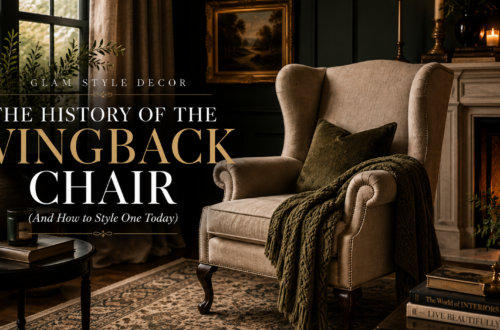
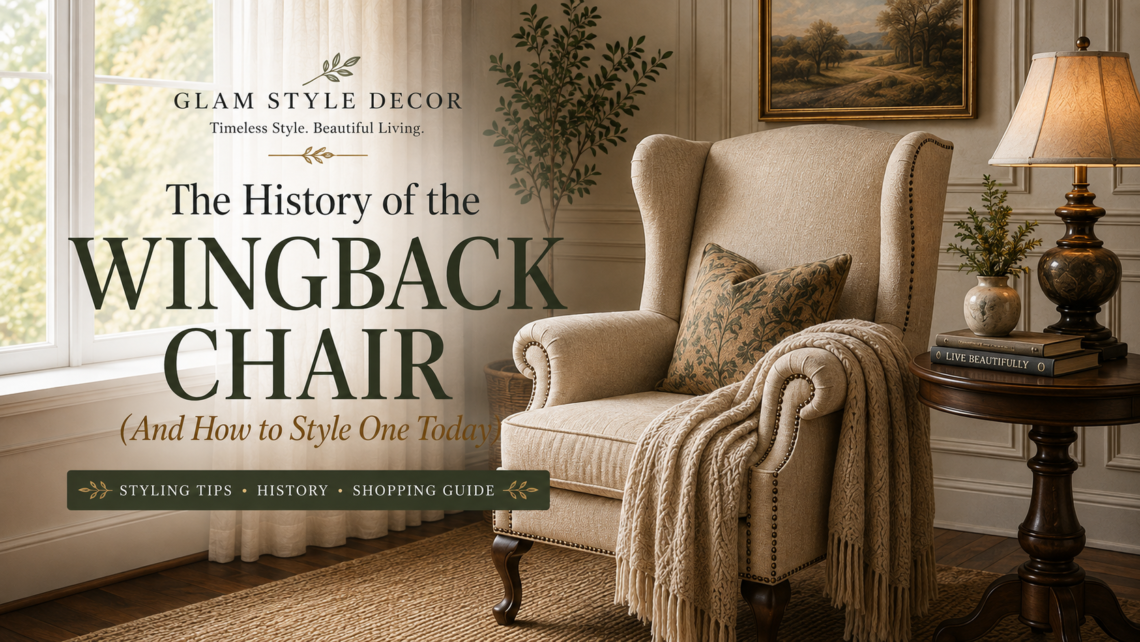
In the first piece on this chair, we covered the basics — where the wingback came from and how to style one today. This one goes deeper, because there’s a lot more to this piece than “old chair with ears on it,” and the fuller story actually changes how you look at every wingback you’ll ever come across.
Late 1600s: Born Out of a Real, Physical Problem
Picture an English manor house in the late 17th century. High ceilings, stone or timber floors, a handful of massive fireplaces trying and failing to heat a genuinely drafty room. If you sat anywhere near one of those fireplaces, you’d get warmth on your front and cold air circulating everywhere else — especially around your head and shoulders, where drafts move most.
The wingback’s tall side panels weren’t decoration. They were a physical barrier, positioned exactly where a seated person’s head and shoulders needed protection, designed to trap the fireplace’s heat close to the body instead of letting it dissipate into the room. This is where the chair earned its lesser-known name: the fireside chair. That name tells you more about its original purpose than “wingback” ever will.
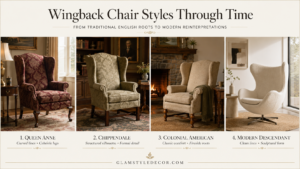
Queen Anne Era: Function Starts Becoming Form
As the design moved into the early 1700s, under Queen Anne’s reign, something shifts. The wingback softens — curved lines replace the boxier, more austere shapes that came before it (a deliberate departure from the plain, utility-first furniture that dominated England under Puritan influence). This is also roughly when cabriole legs — that distinctive curved leg shape — start appearing on wingbacks, adding an elegance the earliest versions didn’t have.
By this point, owning a wingback wasn’t just about staying warm. It had become a visible marker of status — proof you could afford both the fireplace and the labor-intensive upholstery the chair required.
Chippendale and the Formalizing of the Shape
Later in the 18th century, furniture maker Thomas Chippendale and his contemporaries took the wingback further into architectural territory — straighter legs, more carved detail, firmer, more structured profiles. This is the era that produced the wingback most people picture when they hear the word: tall, formal, richly upholstered, clearly meant to be seen in a library or a drawing room, not just a fireside corner.
The Chair Crosses the Atlantic
The wingback didn’t stay in England. Colonial Americans adopted the style, and it became a genuine staple in early American interiors — proof that a design built to solve an English drafty-manor problem was flexible enough to matter somewhere completely different, for reasons that weren’t identical to its original purpose.
The Modern Detour: How the Wingback Got Reinvented
Centuries later, the wingback’s core idea — a high-backed chair that wraps and encloses the sitter — got a genuinely radical reinterpretation. In 1958, Danish designer Arne Jacobsen created the Egg Chair: a smooth, cocoon-like silhouette on a chrome base that owes a real conceptual debt to the wingback’s enclosing shape, even though it looks nothing like its 17th-century ancestor. Scandinavian designers, more broadly, took the wingback’s function — comfort, enclosure, a sense of retreat — and stripped away almost every trace of its ornate English origins.
That’s the real throughline worth understanding: the wingback survived not because any one version of it stayed popular, but because the underlying idea — a chair that wraps around and protects you — kept getting reinvented generation after generation.
Why Central Heating Didn’t Kill It
Here’s the part that should have ended the wingback’s story: once homes got central heating, the entire original function — blocking drafts, trapping fireplace warmth — became unnecessary. And yet the chair didn’t disappear. It’s arguably more popular now than at almost any point in its history.
That’s because somewhere along the way, the wingback stopped being valued for what it *did* and started being valued for what it *represents*: a shape that reads as considered, established, intentional. The name still describes the form. It no longer describes the function. Most people buying a wingback today have never thought about drafts once.
What This History Actually Means for How You Buy One
Knowing this changes what you’re actually choosing between when you shop for a wingback:
- A tall, heavily-tufted, cabriole-leg version is pulling from the Queen Anne era — pick this if you want a traditional, formal statement.
- A straighter-legged, more architectural version is pulling from the Chippendale period — a slightly more structured, less curvy traditional look.
- A low-profile, clean-lined modern wingback is the Scandinavian-influenced descendant — same enclosing comfort, none of the ornate English formality.
None of these is more “correct” than the others. They’re different chapters of the same 300-plus-year story, and knowing which chapter a piece is pulling from is exactly the kind of knowledge that separates someone who’s just decorating from someone who actually understands what they’re buying.
For styling specifics — fabric versus leather, wood versus metal legs, and how to actually place a wingback in a modern room — see the companion piece: The History of the Wingback Chair (And How to Style One Today).