A small bedroom that needs to hold a bed, a dresser, and real storage isn’t a design problem you solve with clever styling tricks alone — it’s a math problem first, and a styling problem second. Get the sizing and furniture selection right, and the room will feel considerably larger than its square footage suggests.
Measure Before You Shop
Measure your room’s full dimensions, then map out door swing, closet access, and window placement before choosing furniture. Most small-bedroom furnishing mistakes happen because a piece was chosen before the room’s actual constraints were understood.
Choose the Right Bed Size for the Room
A queen bed in a genuinely small room can consume so much floor space that nothing else fits comfortably. In tighter rooms, a full or even a well-chosen twin can leave enough clearance for a dresser and walking space, which ultimately makes the room more livable day to day.
Beds With Built-In Storage
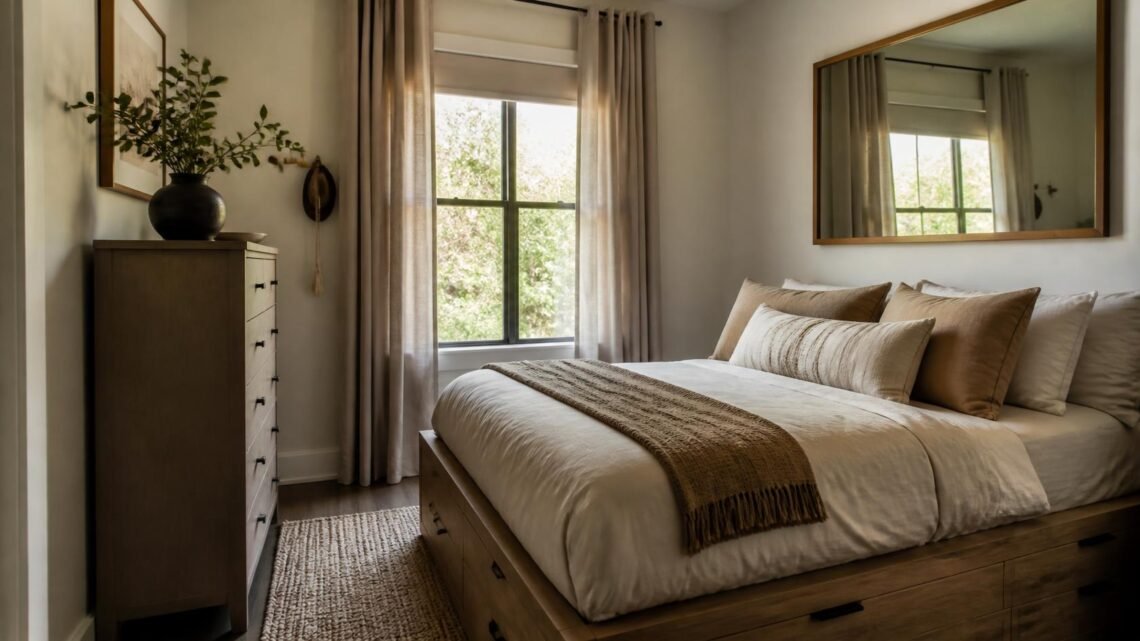
A platform bed with drawer storage underneath, or a bed frame with a storage headboard, can absorb a meaningful portion of what a separate dresser would otherwise need to hold. This is one of the most efficient upgrades available for a small bedroom specifically.
Vertical Dressers Over Wide Ones
A tall, narrow dresser holds nearly as much as a wide, low one while taking up significantly less floor space. In a small room, floor space is almost always more valuable than a few extra inches of drawer width.
Closed Storage Over Open Shelving
In a small bedroom, open shelving tends to visually clutter the room even when it’s organized. Closed storage — a dresser, a cabinet, or under-bed bins — keeps the room feeling calm and finished rather than busy.
Nightstands That Scale to the Room
A slim wall-mounted shelf or a narrow nightstand with a single drawer provides the function of a nightstand without eating into walking space. In very tight layouts, even a small wall-mounted ledge can serve the same purpose.
Mirrors to Add Perceived Space
A large mirror, particularly one placed to reflect a window, makes a small room feel more open without requiring any layout changes. This is one of the lowest-cost, highest-impact additions available.
Furniture Placement That Preserves Flow
Keep the path from the door to the bed and closet as clear as possible, even if it means placing the bed against a less obvious wall. A room that’s slightly less symmetrical but easier to move through will always feel more comfortable than a perfectly centered layout that leaves no walking space.
What to Buy First
Start with the bed, sized appropriately to the room rather than defaulting to the largest size you can technically fit. Follow with a vertical dresser or storage-bed solution, then a scaled-down nightstand, then the finishing layer of a mirror and soft furnishings.
Where to Spend vs. Where to Save
Spend on a well-made storage bed or dresser — these do the most functional work in a small room and are worth the investment in quality construction. Save on decorative accents and bedding, which are easy to change later without affecting the room’s overall function.
Small Doesn’t Mean Cramped
A small bedroom feels cramped when furniture is chosen without regard to scale, not because of the square footage itself. Choose pieces sized intentionally for the room, prioritize closed storage, and the space will function — and feel — far larger than its actual dimensions.